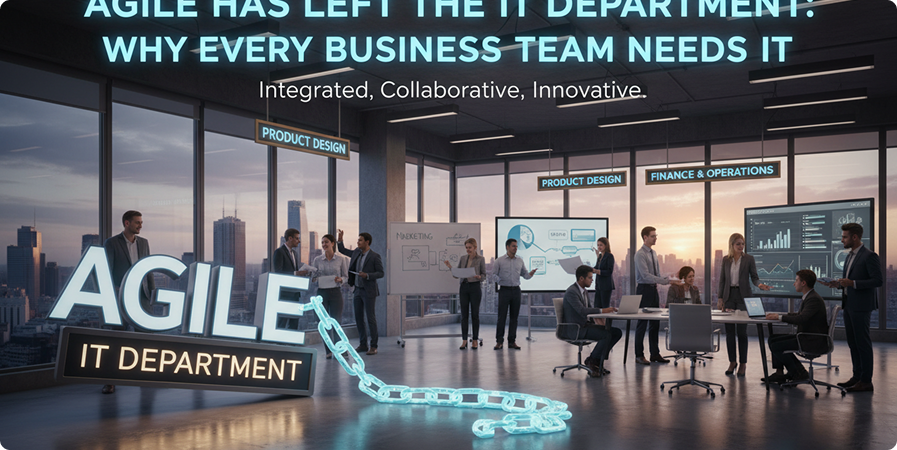
What started as a way for software teams to build better products has become a language for modern work: faster learning, clearer priorities, stronger collaboration, and the ability to adapt without losing direction. Today, Agile and Scrum are not only useful for developers. They are useful for HR teams redesigning employee experience, marketing teams testing campaigns, operations teams improving processes, consulting teams delivering client value, and leadership teams managing transformation. Agile is not a board. It is a behavior. Many organizations say they are Agile because they use boards, sticky notes, daily meetings, or sprint names. But Agile is not a decoration for the workflow. It is a way of thinking and working. Agile means delivering value in smaller steps, learning from feedback, and improving continuously. It means teams do not wait until the end of a long plan to discover whether they are moving in the right direction. The real question is not “Do we use Agile terms?” The real question is “Do we learn faster and deliver better?” Why business teams need Agile now. Business environments have become unpredictable. Customer expectations change. Internal priorities shift. Market pressure increases. Traditional plans can still be useful, but when uncertainty is high, teams need a way to adjust without becoming chaotic. Agile gives teams that structure. It helps them prioritize the most valuable work, collaborate more openly, reduce wasted effort, and respond to feedback before it is too late. A marketing team can use Agile to test messages weekly instead of waiting until a full campaign is over. An HR team can redesign onboarding through small experiments. An operations team can improve a process step by step based on real evidence.

Scrum provides a framework for organizing work into short cycles. Teams plan, deliver, review, and improve. The structure looks simple, but successful Scrum requires discipline, clarity, ownership, and honest feedback. Without proper understanding, Scrum can become a calendar full of meetings. With the right mindset, it becomes a rhythm for progress. This is why Agile and Scrum training must go beyond terminology. Learners need to understand roles, responsibilities, prioritization, feedback loops, and the behaviors that make collaboration work. The mistakes that make Agile fail. Agile initiatives often fail when organizations copy the rituals but ignore the mindset. They hold daily meetings with no value, use boards without accountability, overload teams with too much work, or measure activity instead of outcomes. Real Agile requires leadership support. It requires teams to be honest about priorities, transparent about obstacles, and committed to improvement. It requires managers to stop treating change as disruption and start treating feedback as intelligence. PMEC and the business side of Agile. PMEC’s Agile courses support professionals and organizations that want to work with more flexibility, clarity, and value focus. Agile connects naturally with project management, business analysis, leadership, corporate training, and transformation initiatives. For organizations, Agile is not about becoming less structured. It is about becoming more responsive without losing control. The future of work will not reward the teams that only plan perfectly. It will reward the teams that learn quickly, adapt intelligently, and deliver value consistently.